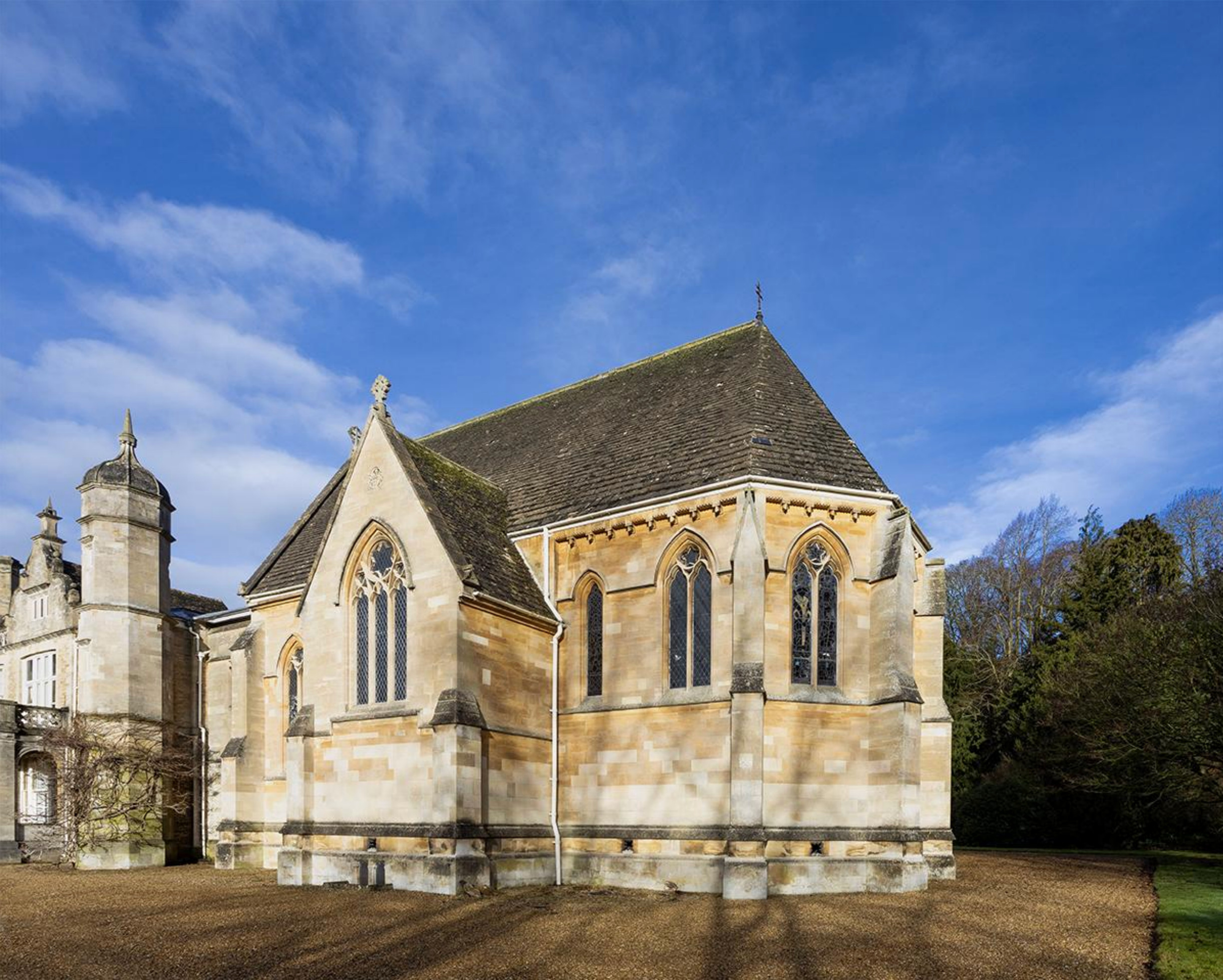

St Thomas of Canterbury Chapel, Exton Estate , photograph by Gerry Weatherhead, Exton March 2026
The foundation of St Thomas of Canterbury Chapel on the Exton Estate in the late nineteenth century is a notable milestone in the revival of Catholic worship in England. After the Reformation and Henry VIII’s Act of Supremacy, Catholic Mass was outlawed under Elizabeth I in 1559. Legal restrictions on Catholic practice were gradually relaxed, culminating in the Catholic Relief Act of 1791, and the Oxford Movement of the 1830s which renewed interest in traditional Catholic rites within Anglicanism. Yet Rutland did not see a Latin Mass again until the mid-nineteenth century, when the influence of the Noel family brought it back.
The chapel stands adjacent to Exton Hall and has served the Catholic community of Exton for nearly 160 years. Its creation grew from a marriage union: in 1841 Charles George Noel (1818–1881), son of the 1st Earl of Gainsborough, married Lady Ida Harriet Augusta Hay (1820–1867), the granddaughter of William IV and Mrs Jordan; Ida had been a bridesmaid to Queen Victoria the previous year. The couple travelled widely in Europe and, influenced by the Oxford Movement and their time in Rome, developed a strong Catholic sympathy. By late 1850 both Charles George and Ida had converted to Catholicism and were received into the Church by Pope Pius IX on 1 January 1851. Their conversion caused controversy – three of Charles’s uncles were Anglican clergymen – but it did not produce a lasting rupture within the Noel family. On his father’s death in 1866, Charles George succeeded as the 2nd Earl of Gainsborough and inherited the Exton estate.
The chapel was commissioned by the 2nd Earl and designed by Charles Alban Buckler (1825–1905), an architect, author and artist who converted to Catholicism in 1844 and went on to design more than twenty Catholic churches and chapels in England. Historic England later described Buckler as one of the most distinguished early to mid-Victorian Catholic architects.
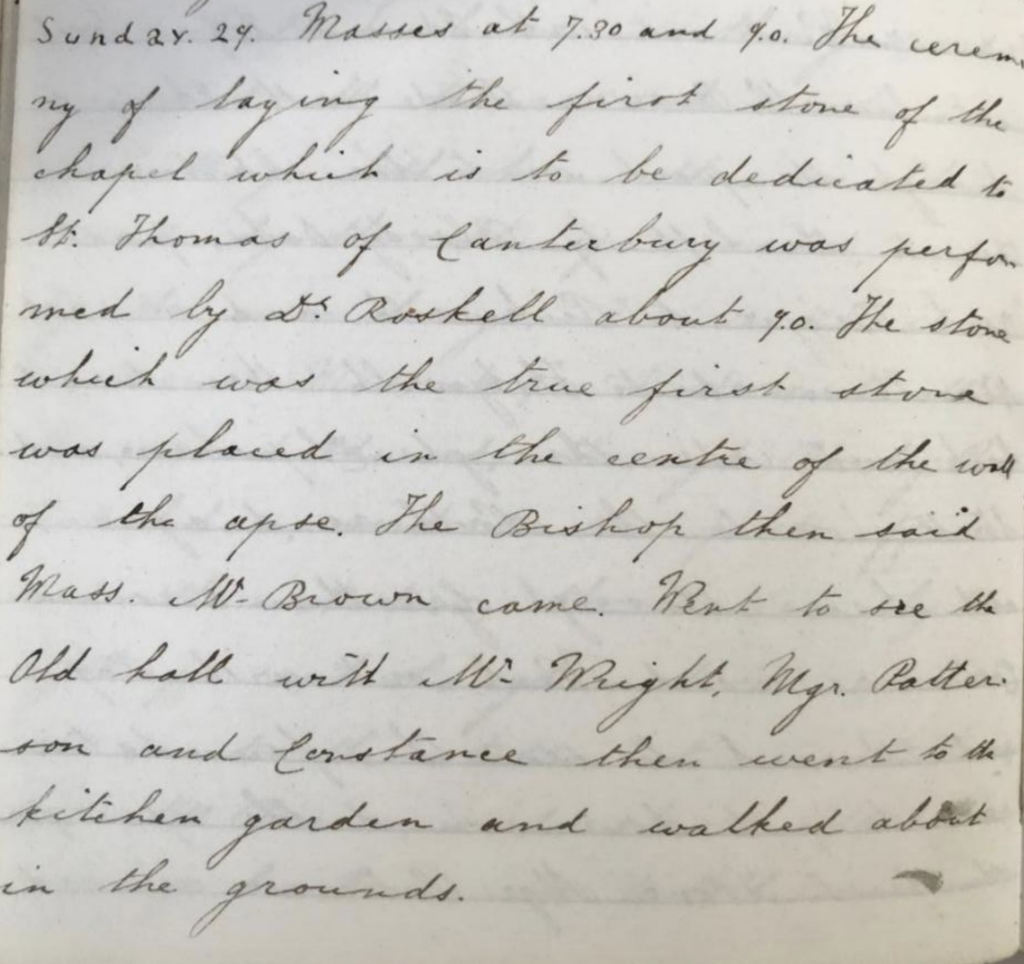
A contemporary diary kept by the 2nd Earl’s eldest son, Charles William Francis Noel (1850–1926), records key moments in the chapel’s early history. On Sunday 11 August 1867 he wrote with emotion of what he called “the first Mass ever said at Exton since the Reformation 300 years ago glorious!” This Mass is likely to have taken place in a small chapel in the main Hall itself as the new chapel building had not yet been constructed. On Sunday 29 December 1867 he recorded the Bishop of Nottingham laying the first stone for the new chapel, noting that “the true first stone was placed in the centre of the wall of the apse.” By December 1868 the roof was slated and internal work had begun.
The chapel was officially opened on 7 July 1869, the Feast of Translation of Saint Thomas of Canterbury, a day which commemorates the transfer of the relics of Saint Thomas Becket from the crypt of Canterbury Cathedral to a new shrine in the Cathedral. The Bishop of Nottingham sang the Latin Mass. Henry Edward Manning, who had been appointed Archbishop of Westminster four years before, occupied a throne at the Gospel side, his red Vestments made from robes worn by the first Earl of Gainsborough at the coronation of Queen Victoria. Manning was a convert to Catholicism and a prominent figure in the Oxford Movement, and in his role as Archbishop he promoted the building of Catholic schools and institutions, which aligned with the 2nd Earl of Gainsborough’s passion. The large gathering that day included Gainsborough and his children and friends, the chaplain Reverend G. Munro, the Bishops of Birmingham and Northampton and Catholic clergy from Ramsgate and Melton. Before the Mass commenced, the chapel was blessed by the Reverend Munro, the cross-bearer being the chapel architect Charles Buckler. After the Mass the visitors were entertained by the Earl of Gainsborough in Exton House, and the grounds were thrown open to all residents of Exton and villagers from the local area.
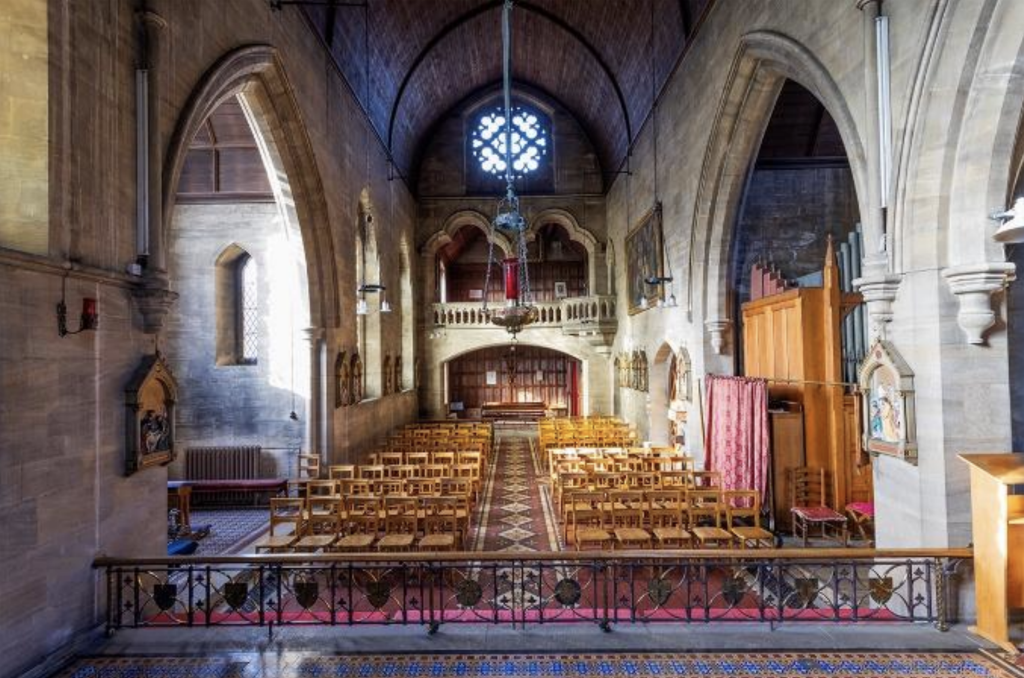
View of chapel from the altar, photograph by Gerry Weatherhead, Exton, March 2026
The chapel is attached to the east side of Exton Hall, forming an extension of the south front, and communicates with the ground and first floors of the Hall by the antechapel. The style of the architecture is that of the latter part of the thirteenth century, the external walls dressed in cut Clipsham stone and the inside with stone from the Exton-park quarry. The high altar was sculpted by Thomas Earp of Lambeth, and its fine carvings depict St. Thomas Becket as Archbishop of Canterbury and the penitential pilgrimage of King Henry II to his shrine. The stained-glass window behind the altar was commissioned by Mary Dease, Countess of Gainsborough in about 1928-1930 as a memorial to Lady Agnes Noel, the Honourable Robert Noel and five other Exton boys who died for their country in the First World War. The artwork was created by the leading Dublin stained-glass artist Harry Clarke. Clarke was highly skilled and some of his other pieces feature in the Victoria & Albert Museum; for many experts his skill represents the peak of post-medieval achievement in stained glass. Another stained-glass window has fragments of 15th and 16th century glass, re-set between 1878 and 1880. The coloured pieces originate from the shattered windows of Exton’s Anglican St Peter and St Paul Church, which was struck by lightning in 1843. Depicted are the Harington Fret, the Tudor red rose, the crowned head of Christ and a stag which is the Noel crest.
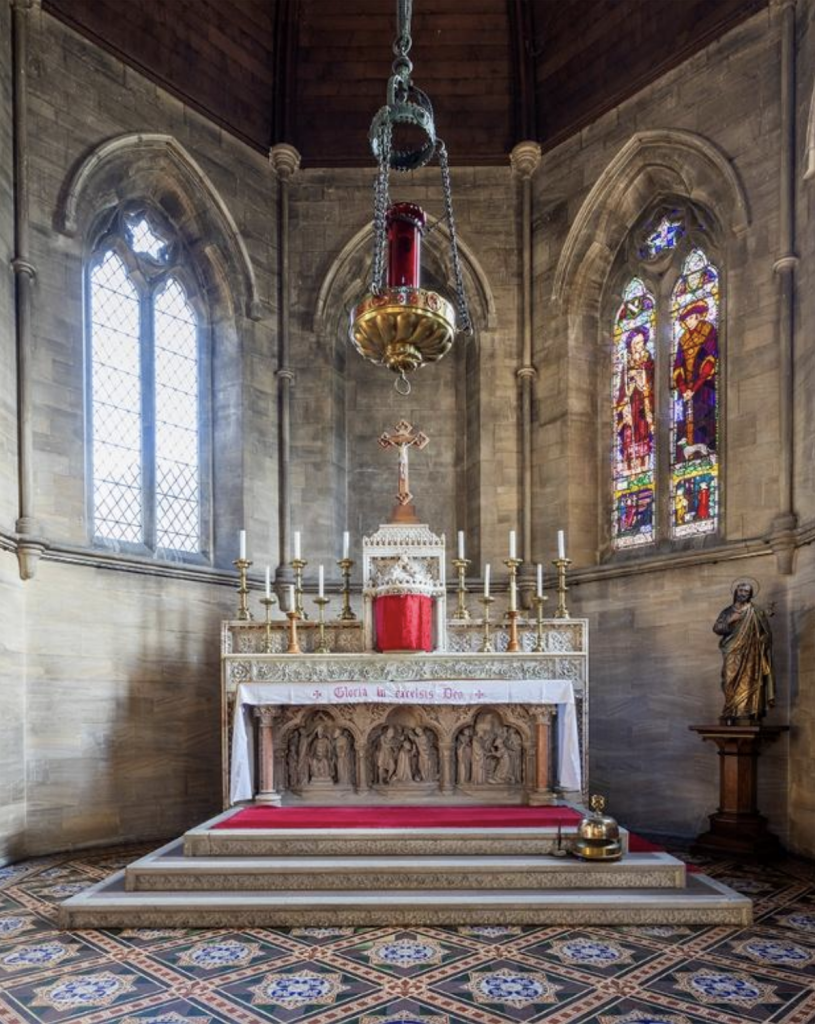
The altar, photograph by Gerry Weatherhead, Exton, March 2026
Charles George Noel and Lady Ida supported the wider growth of Catholic institutions, including schools such as St Mary’s School in Exton. The chapel on their estate stands as a tangible sign of Catholic re-establishment in nineteenth-century England. As the Catholic Newsletter The Tablet observed in July 1869, “This is the first public Catholic Church which has been opened in Rutlandshire for three hundred years. There is now not a county in England without a Catholic church.”
The chapel remains an important historic and spiritual landmark on the Exton Estate, reflecting both the personal convictions of the Noel family and the broader religious shifts of the Victorian era.
Nick Fisher, March 2026
Acknowledgements:
Thank you to the Exton Estate, in particular the Countess of Gainsborough and the Viscount and Viscountess Campden for their generous loan of materials and permission to take photographs of the Catholic chapel. Also of great help were Father Vellacott, RC priest of Oakham, and John Boland-Lee, a former volunteer with the Diocesan Archives who continues to support the current archivist of the Nottingham diocese, Father Kevin Athaide. Facts included in this short history have been corroborated by cross-referencing with a number of sources:
• The Countess of Gainsborough’s history of the chapel, 2010
• Historic England
• Rutland’s Phoenix: The Archives of the Noel Family of Exton Park Rutland, An Introduction and Essays, edited by Rachael Marsay
• Catholic Newsletter, The Tablet, dated 10 July 1869
• Letters between Charles George Noel and architect Charles Alban Buckler from the Exton Collection held at the Leicester Records Office in Wigston Magna
• Diary of Charles William Francis Noel
Diary of Charles William Francis Noel (below)
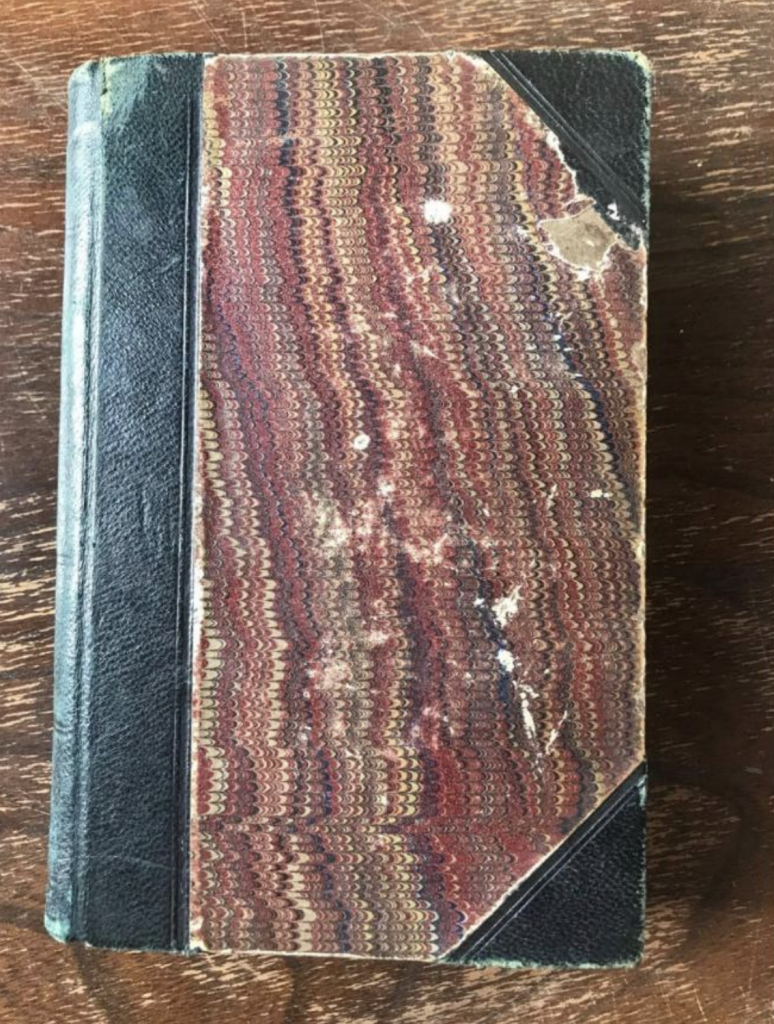
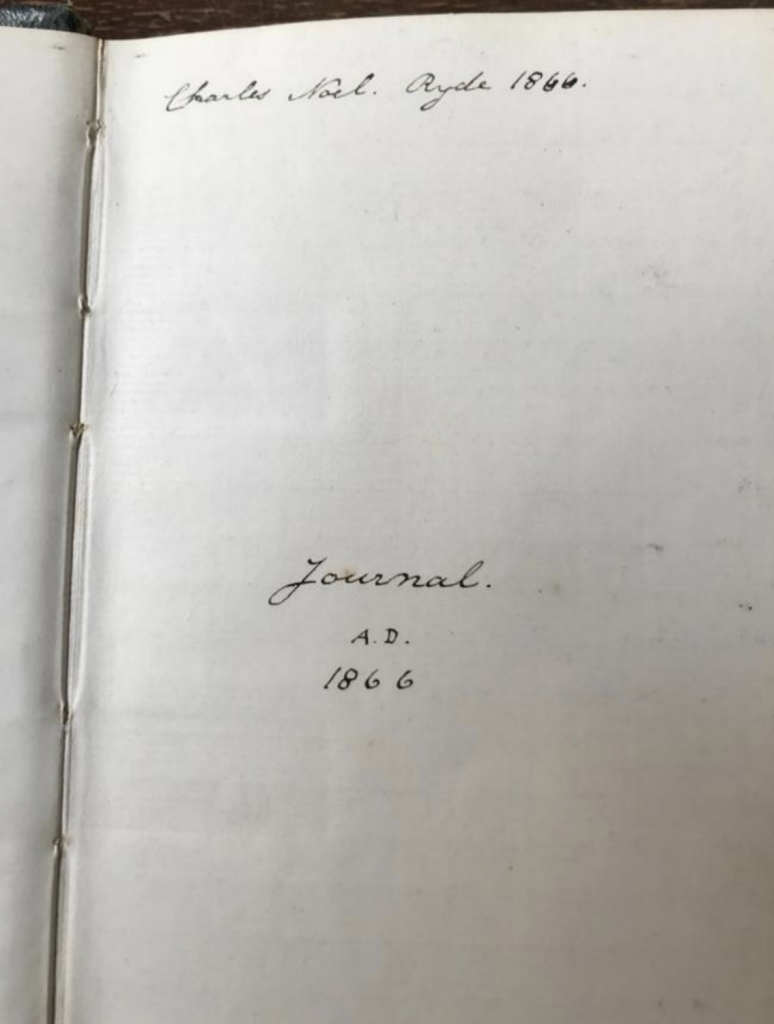
An extract from the Charles William Francis’ diary Sunday 11 August, 1867 emotionally records the first Mass in Rutland since the Reformation,
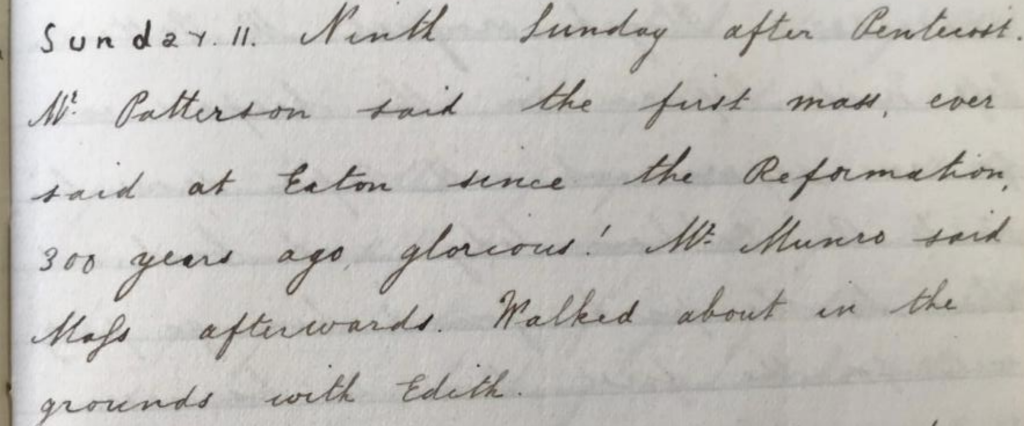
“…the first mass ever said at Exton since the Reformation 300 years ago glorious!”
This Mass is likely to have taken place in a small chapel in the main Hall itself as the new chapel building had not yet been constructed.
A few months later, on Sunday 29 December, 1867 the diary entry describes the first stone being laid for the new chapel by the Bishop of Nottingham, “… the true first stone was placed in the centre of he wall of the apse.”